

Modern microscopy,
redefined
Digital holographic microscopy (DHM) is a non-invasive imaging technique that captures phase and amplitude information of the light wave by recording the interference pattern of laser light passing through and around a sample. This hologram is then computationally reconstructed to generate high-resolution, 3D images of cells or particles, all without the need for stains or dyes. DHM preserves the natural state of the sample while providing detailed structural and topographical information, making it ideal for automated and integrated laboratory workflows.

Label-free and non-destructive.
No staining. No cytotoxic effects.

Quantitative phase imaging. Precise and reproducible.

Software driven. Hardware light. Designed for robustness and ease of use.
How it works
From light to insight
Digital holographic microscopy is an advanced imaging technique that captures detailed, quantitative phase information without the need for stains or dyes. This non-invasive method reconstructs high-resolution 3D images of cells and particles, while preserving their natural state.

1. Illumination
A coherent light source illuminates the sample. Microscopic objects in the optical path scatter the light.

2. Hologram
The scattered light interacts with the original wavefront, forming an interference pattern – the hologram.

3. Reconstruction
Algorithms reconstruct phase and amplitudes to create quantitative 3D images.

4. Classification
Machine learning models detect and classify cells and particles for the specific application.

OEM ready module –
what’s inside?
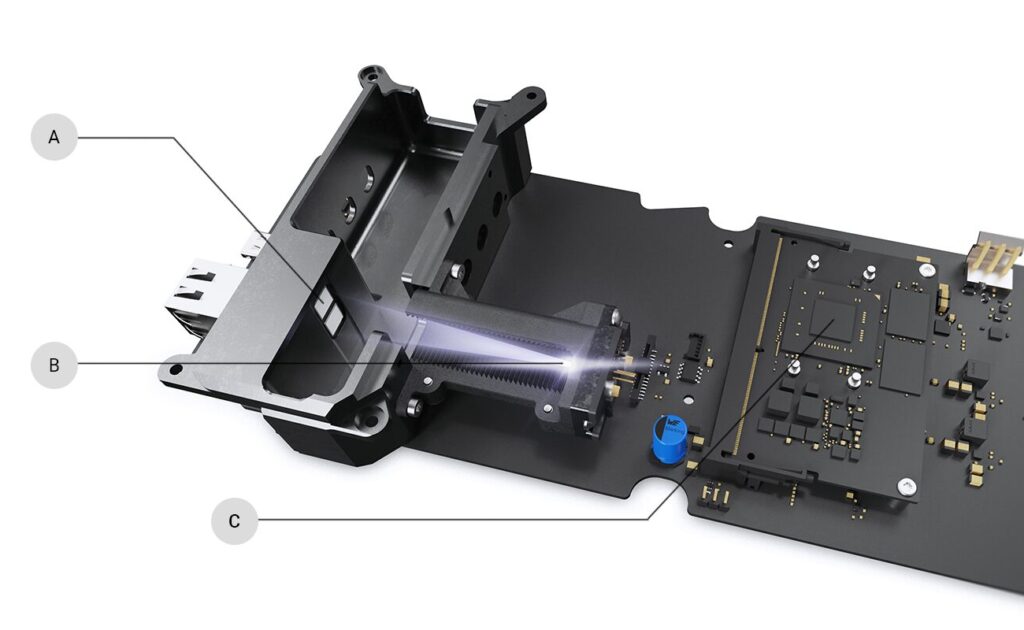
Our digital holographic microscopy module combines streamlined hardware with advanced software. Designed for seamless integration into diagnostic devices or compact lab systems.
(A) CMOS sensor:
Captures high-resolution holograms
(B) Illumination unit:
Coherent LED or laser light source
(C) DHM software stack:
Digital reconstruction, object detection & AI classification
Why DHM?
Compact. Reliable. Easy to integrate.
| Feature | Advantage |
|---|---|
| Compact optical setup | Minimal footprint for easy integration |
| No moving parts | High robustness, low failure risk |
| Scalable production | Simple design enables cost-efficient manufacturing |
| Versatile compatibility | Works with diverse sample carriers, incl. microfluidics |
Use cases in practice
Digital holographic microscopy accelerates imaging across industries:
- Veterinary diagnostics: fast, label-free urine analysis (fluidlab 1)
- Clinical labs: automated blood and body fluid imaging
- Biomedical research: cell morphology & viability studies (fluidlab R-300)
- Food industry: detection of microorganisms for quality control
- Material sciences: precise analysis of microparticles
Applications of digital holographic microscopy

Clinical diagnostics
Enables rapid urine analysis, blood cell counting and pathogen detection.

Biomedical research
Studies cell morphology and interactions to uncover disease mechanisms.